

Braces and appliances
Every type of brace has its strengths. Which one is right for you depends on your findings and your age. We give you honest, personal advice.
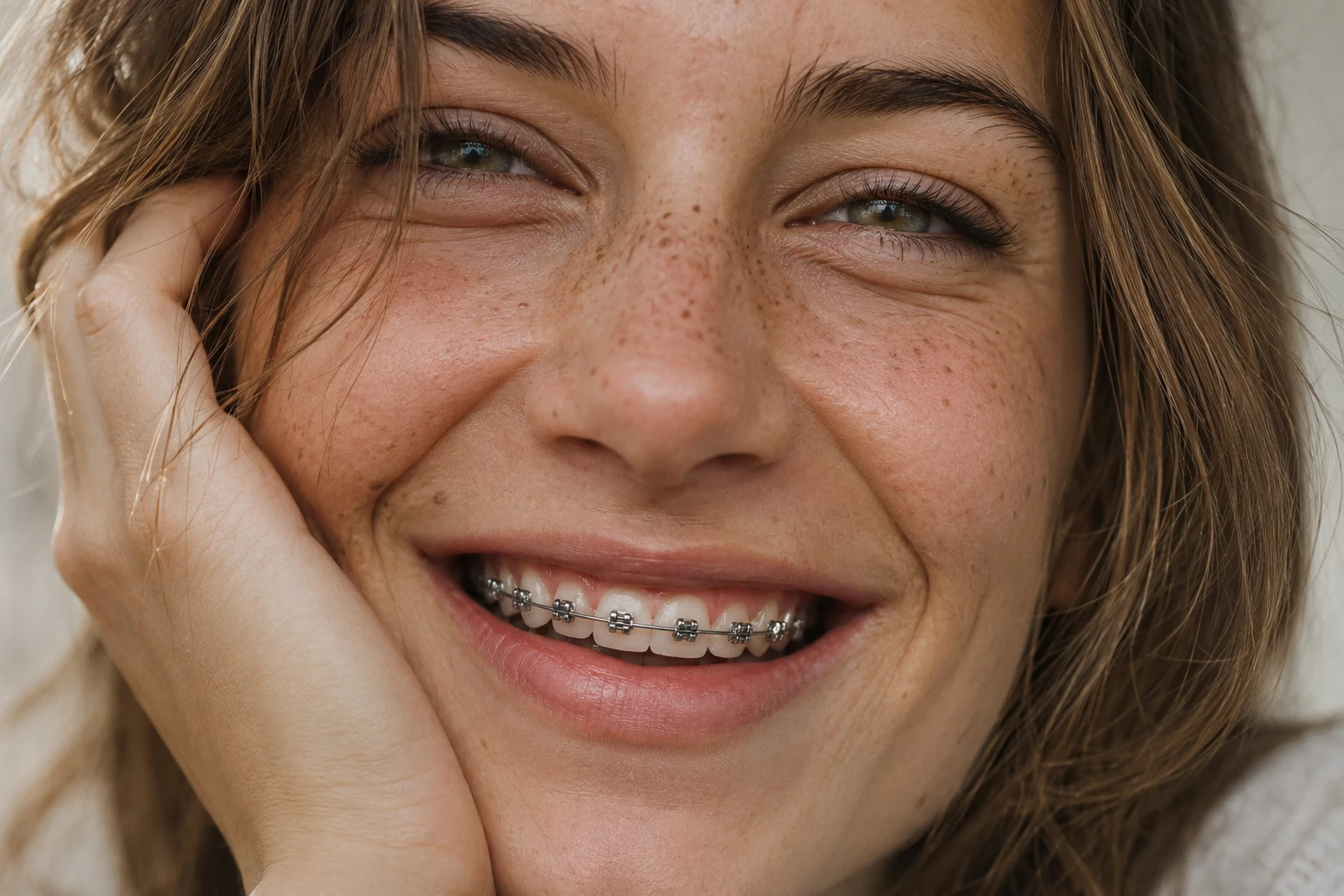
Brackets: precise and working around the clock
Small brackets are bonded to the teeth and connected by an archwire. With finely measured forces we move each tooth precisely into place. This also allows us to correct rotated teeth and the position of the roots.
- Metal brackets: proven, small and robust
- Ceramic brackets: tooth-coloured and very inconspicuous
- Works without you having to think about wearing it
- Check-ups about every 4 to 8 weeks
Clear aligners, almost invisible
A series of custom-made, transparent aligners moves the teeth in small steps. We work with Invisalign and Angel Aligner. Depending on the treatment plan, you change to the next aligner every one to two weeks and only take them out to eat and brush your teeth.
- Suitable for many cases of crowding, gaps and minor bite corrections
- Worn for 20 to 22 hours a day, so discipline matters
Guiding growth in children
Removable appliances are mainly used in the mixed dentition, while the baby teeth are being replaced. They widen the jaw, create space or correct the bite. Their success depends directly on how long they are worn. Check-ups are needed about every 6 to 8 weeks.
Expansion and bite plate
A screw in the plate gradually widens the upper jaw. With a bite plane, it can also open a deep bite.
Functional appliances
For example a twin block or an activator (monoblock). They hold the lower jaw in a forward position and so improve the bite.
Small appliances with a big effect
Palatal expander (Hyrax)
Widens an upper jaw that is too narrow, for example in a crossbite. The screw in the middle of the palate is activated according to a set plan.
Quad-helix
A springy wire arch on the palate gently widens the upper jaw and can correct rotated upper molars.
Space maintainer
Keeps the gap open for the permanent tooth after a baby tooth has been lost early.
Additional anchorage
Sometimes a stable anchor is needed so that only the intended teeth move. This can be done from outside with headgear or directly in the bone with mini-implants.
Headgear
A facebow attached to a neck strap or a headcap. It is worn mainly in the evening and at night, usually 10 to 14 hours a day. It slows the growth of the upper jaw or moves the upper molars backwards.
Skeletally anchored appliances
Mini-implants are small titanium screws, usually placed in the palate under local anaesthetic in a few minutes. As a stable anchor they support, for example, palatal expansion or allow molars to be moved without headgear. They are removed after treatment.
When the lower jaw is set far back
The Herbst appliance is a fixed appliance that guides the lower jaw forward. Because it cannot be taken out, it works regardless of cooperation, even in teenagers towards the end of growth.
- Usually worn for 6 to 12 months
- Corrects a large overjet quickly
- Chewing takes a little getting used to in the first few days
Keeping the result stable
After active treatment, teeth tend to move back towards their old position. Retainers keep the result stable.
- Fixed retainer: a fine wire on the inside of the front teeth, in the upper and lower jaw
- Removable retainer: as an alternative to the fixed retainer or in addition to it
- Retention activator: sometimes used after correcting a large overjet, for example with the Herbst appliance. It is worn at night and holds the lower jaw in its new position until growth and muscles have adapted. This is when the risk of relapse is greatest.
- Duration of retention: teeth can shift slightly throughout life, so we recommend long-term retention.
Which brace is right for you?
In the first consultation we show you the options for your findings, with their advantages and disadvantages.